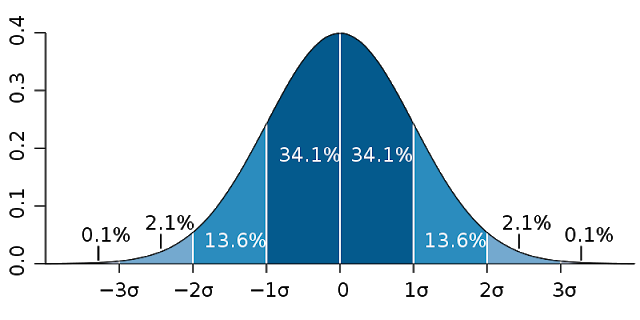
We know that a random variable distribution must satisfy the fundamental probability density function (PDF) requirements for a continuous random variable:
f(x)≥0, for all x∈R
∫−∞∞f(x)dx=1
P(a<X<b)=∫abf(x)dx
These conditions ensure that the function is a valid probability model over the continuous sample space.
To prove that the total area under the normal distribution curve is equal to 1, we evaluate:
P(−∞<X<∞)=∫−∞∞f(x)dx
Substituting the normal distribution PDF:
=∫−∞∞σ2π1e−2σ2(x−μ)2dx
Standardization Transformation
Let:
z=σx−μ
Then:
x=σz+μdx=σdz
Substituting:
=∫−∞∞σ2π1e−2σ2(σz+μ−μ)2σdz
Simplifying:
=∫−∞∞2π1e−2z2dz=2π1∫−∞∞e−z2/2dz
Relating to the Gaussian Integral
Recall:
∫−∞∞e−y2dy=π
To match this form, let:
y=2z
Then:
z=2ydz=2dy
Substituting:
=2π1∫−∞∞e−(2y)2/22dy
Simplifying:
=π1∫−∞∞e−y2dy
Using the Gaussian integral result:
=π1⋅π=1
Final Result
P(−∞<X<∞)=∫−∞∞f(x)dx=1
Thus, it is proven that the total area under the normal distribution curve is exactly 1, satisfying the fundamental requirement of a valid probability density function.